
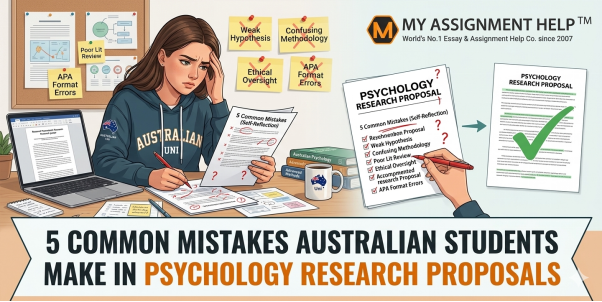
Crafting a psychology research proposal is arguably the most critical milestone for any undergraduate or Honours student in Australia. It serves as the blueprint for your thesis, dictating the feasibility of your ethics approval and the eventual success of your data collection. However, navigating the stringent guidelines set by the Australian Psychology Accreditation Council (APAC) and individual university Human Research Ethics Committees (HREC) can be a minefield.
In the competitive Australian academic landscape, where clinical Masters placements are highly sought after, the quality of your research output matters immensely. Many students find themselves overwhelmed by the dual demand of theoretical rigor and methodological precision. For those struggling to align their organizational theories with empirical frameworks, seeking expert business psychology assignment help can provide the necessary clarity to bridge the gap between abstract concepts and actionable research designs.
Understanding these pitfalls early can save months of revision. Below, we dissect the five most frequent errors identified by Australian academic supervisors and how to avoid them.
.png)
1. Vague Problem Statements and Overly Broad Scopes
The most common feedback from supervisors at institutions like the University of Melbourne or ANU is that a proposal is “too ambitious.” Australian students often attempt to solve “depression in youth” or “workplace stress” in a single 12,000-word thesis. A research proposal is not a manifesto; it is a specific question that can be answered within a 6-to-9-month timeframe.
The Fix: Use the PICOT framework (Population, Intervention, Comparison, Outcome, Time) to narrow your focus. Instead of “Mental Health in Australia,” focus on “The impact of telehealth-delivered CBT on social anxiety among rural Victorian adolescents aged 15-18.”
2. Ignoring the “Australian Context” in Literature Reviews
While psychology is a global science, Australian markers look for “local relevance.” Relying solely on North American (APA) data without referencing the Australian Bureau of Statistics (ABS) or the Australian Institute of Health and Welfare (AIHW) can lead to a disconnect in your rationale. If you are researching indigenous psychology, for instance, failing to account for the NHMRC’s guidelines for ethical conduct in Aboriginal research is a fatal flaw.
3. Methodological Misalignment and Underpowered Samples
A significant number of proposals fail because the proposed analysis (e.g., a complex SEM model) is impossible to execute with the sample size the student can realistically recruit. In Australia, recruiting clinical populations through public health systems (like NSW Health) is notoriously slow and difficult for students.
The Fix: Conduct a G*Power analysis before submitting your proposal. If you cannot justify how you will recruit 150 participants for a medium-effect-size correlation, your proposal will likely be rejected by the ethics committee. If the workload feels insurmountable, it’s common for students to reach out to professionals to do my homework for me to help structure their methodology and data analysis plan.
4. Ethical Oversights and “Boilerplate” Risk Assessment
Under the National Statement on Ethical Conduct in Human Research, Australian HRECs are rigorous. Many students treat the “Risk to Participants” section as a formality, failing to detail specific mitigation strategies for psychological distress. In psychology research, “low risk” does not mean “no risk.” You must provide a specific “Distress Protocol”—such as providing contact details for Lifeline or Beyond Blue.
5. Poor Narrative Flow and “Siloed” Writing
A proposal should read like a story where the conclusion (the research question) is inevitable based on the introduction. Often, students write a literature review, then a methodology, but the two don’t talk to each other. Your methodology should be the direct tool used to solve the specific gap identified in your review. If your intro discusses “qualitative nuances” but your method is a “quantitative survey,” your proposal lacks internal validity.
Key Takeaways
- Specificity Wins: Narrow your research question until it feels “too small”—it’s probably just right.
- Local Data: Always complement international studies with Australian-specific statistics from the AIHW or ABS.
- Power Matters: Never propose a quantitative study without a formal power analysis.
- Ethics First: Read the National Statement before drafting your participant information sheets.
Frequently Asked Questions (FAQs)
Q1: How long should an Australian Psychology Research Proposal be?
Typically, for Honours or Masters, they range between 1,500 and 3,000 words, depending on university-specific handbooks.
Q2: Can I change my methodology after the proposal is approved?
Only through an ethics amendment. It is much better to get it right in the proposal stage to avoid bureaucratic delays of 4–6 weeks.
Q3: Do I need to include a budget in the proposal?
Most Australian universities require a “Resource Requirement” section to prove the study is feasible with available lab equipment, software (like SPSS or NVivo), or funding.
Author Bio
Dr. Sarah J. is a Senior Academic Consultant at MyAssignmentHelp. With over 10 years of experience in Australian Higher Education and a PhD in Applied Psychology, she specialises in E-E-A-T compliant academic content and helps students navigate the complexities of HREC approvals and thesis structuring.
References & Sources
- Australian Psychology Accreditation Council (APAC). (2025). Accreditation Standards for Psychology Programs.
- National Health and Medical Research Council (NHMRC). (2023). National Statement on Ethical Conduct in Human Research.
- Australian Institute of Health and Welfare (AIHW). (2024). Mental Health Services in Australia Report.
- Australian Bureau of Statistics (ABS). (2024). National Study of Mental Health and Wellbeing.