
Introduction
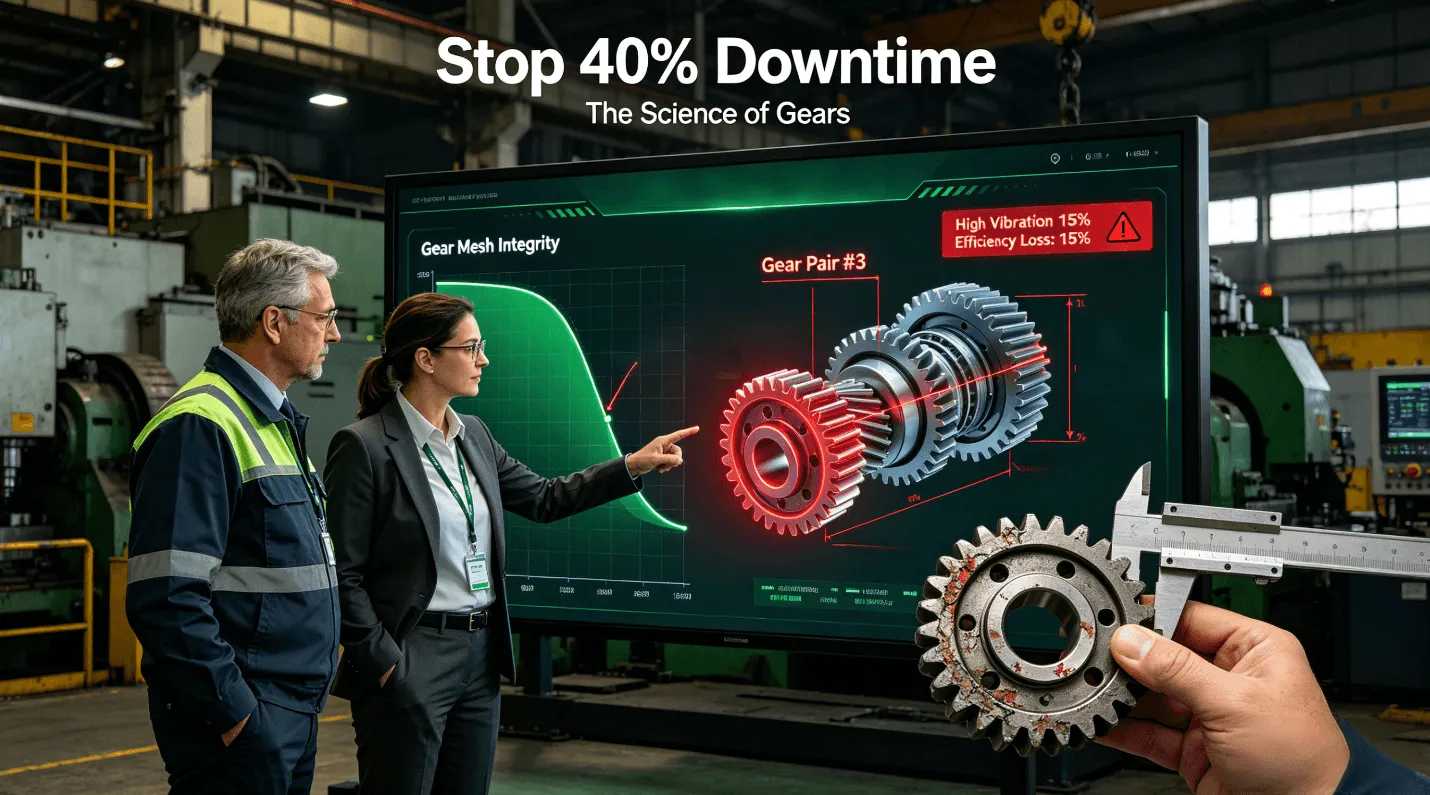
Unplanned downtime is a primary profit-killer in manufacturing. A common yet often hidden root cause is the improper specification of industrial gears, specifically the selection of incorrect dimensions or inappropriate manufacturing tolerances. Sub-optimal gear sizing can trigger a cascade of failures, leading to premature wear, excessive vibration, and a drastic decline in power transmission efficiency. Ultimately, this results in costly transmission system breakdowns, massive production losses, and expensive emergency repairs.
The core problem frequently stems from treating gears as simple “stock components” chosen from catalogs based on basic numbers, while overlooking the critical interplay of precise manufacturing tolerances, specific application load profiles, and overall system compatibility. Relying on generic data rather than engineering calculations is the starting point for failure. This article provides a decision-making framework, demonstrating how to deeply bind gear size, specification, and precision grade to specific performance demands, and argues that partnering with a manufacturer possessing systematic engineering capability and a robust quality system is key to transforming a design into a reliable asset.
What Do “Industrial Gear Dimensions” Really Encompass Beyond Basic Numbers?
True Industrial Gear Dimensions involve a symphony of interlinked specifications far beyond simple module and tooth count. Critical parameters like center distance, the exact distance between the axes of two mating gears, is fundamental; a minute deviation can induce misalignment, leading to uneven load distribution and accelerated wear. Similarly, face width directly governs load-bearing capacity, while the tooth profile geometry, including addendum and dedendum, dictates the smoothness of engagement and contact ratio. Furthermore, controlled backlash — the intentional micro-clearance between meshing teeth — is not an error but a critical design parameter to accommodate thermal expansion and ensure proper lubrication without binding. Understanding this holistic picture of dimensions is the first step toward reliable performance.To comprehensively understand how different types, such as spur and helical gears, influence dimensions and system design, you can refer to this comprehensive guide by leading industrial gears mpanufacturers.
1. The Critical Role of Center Distance in System Longevity
While pitch diameter is fundamental, the center distance between two gears is a master dimension for the entire gear pair. An incorrect center distance, even within a seemingly acceptable tolerance, forces the teeth into a suboptimal contact pattern. Over millions of cycles, this misalignment dramatically increases localized hertzian contact stress, leading to premature pitting, spalling, and ultimately, catastrophic tooth fracture. Ensuring the designed center distance is achieved and maintained in the assembly is therefore non-negotiable for system durability.
2. Face Width and Tooth Geometry: Balancing Strength and Smoothness
Face width is a lever for load capacity; increasing it spreads the load over a greater area. However, an excessively wide face can introduce challenges with manufacturing uniformity and lead to misalignment under load if the housing is not equally rigid. Simultaneously, the precise tooth profile geometry, governed by the pressure angle and fillet radius, controls how the load is transferred from one tooth to the next. An optimized profile maximizes contact ratio for smoother operation and minimizes stress concentration at the tooth root, directly impacting the fatigue life of the component.
3. Backlash: The Essential Margin for Reliable Operation
Controlled backlash is a deliberately designed clearance, not a manufacturing error. It is the small space between the non-driving faces of mating gear teeth that prevents jamming due to thermal expansion, ensures a lubricant film can be maintained, and accommodates minor assembly or deflection variances. Insufficient backlash causes overheating, noise, and excessive wear, while excessive backlash results in positional inaccuracy, impact loads, and vibration. Precise specification and control of backlash are therefore essential for smooth, quiet, and reliable gear operation.
Why Are Manufacturing Tolerances the Unsung Hero of Gear Reliability?
Manufacturing tolerances are the guardians of design intent, translating theoretical dimensions into predictable, high-performance reality. Standards like AGMA or ISO define precision grades (e.g., AGMA 10 vs. AGMA 12) that specify the allowable limits for errors in tooth profile, lead (helix angle), and pitch. A “commercial grade” gear might function, but a “precision grade” gear, with its tighter tolerances, ensures near-perfect conjugate action. This results in dramatically smoother meshing, lower operational noise, higher transmission efficiency, and a vastly extended service life, delivering a superior total cost of ownership despite a higher initial price.
1. Precision Grades: The Universal Language of Gear Quality
Gear precision grades, as codified by organizations like the American Gear Manufacturers Association (AGMA), provide a universal benchmark. A grade specifies the maximum permissible deviations for critical elements like profile error, which affects how the tooth curves mate; lead error, which influences edge contact; and pitch error, which causes transmission irregularity. Specifying and verifying compliance to a recognized grade ensures the gear will perform as predicted, providing a common technical and commercial language between designer and manufacturer for consistent, reliable outcomes.
2. The Performance Delta: Commercial Grade vs. Precision Grade
The operational difference between a loosely and tightly toleranced gear is profound. A gear with wider manufacturing tolerances may have visible profile deviations, leading to concentrated stress points and impulsive loading as teeth engage. This manifests as audible whine or rumble, vibration transferred through the drivetrain, and accelerated wear. In contrast, a precision-grade gear with minimal form error ensures a large, evenly distributed contact pattern, resulting in near-silent operation, minimal vibration, and optimal power transfer, which is essential for high-speed applications or sensitive machinery.
3. Tolerances as a Strategic Investment in Total Cost
Viewing tighter gear manufacturing tolerances solely as a cost adder is a short-sighted perspective. The investment should be evaluated against the total cost of ownership. A precision-machined gear with superior surface finish and geometry runs cooler, consumes less energy, and lasts significantly longer. This translates directly into reduced unplanned downtime, lower energy bills, and deferred maintenance and replacement costs. For critical applications, the long-term savings and risk mitigation far outweigh the higher initial manufacturing cost, making precision a strategic economic decision.
Spur vs. Helical: How Does Gear Type Dictate Size and Performance Under Load?
The fundamental choice between spur and helical gears is a pivotal engineering decision that dictates the size, performance, and reliability of a power transmission system under load. This choice directly influences the physical envelope, load-handling characteristics, and operational behavior of the assembly. Selecting the wrong type for an application can lead to premature failure, excessive noise, or an inefficient, oversized design. Understanding the core differentiators is essential for matching the gear type to the specific demands of torque, speed, and operating environment.
1. Spur Gears: The Pillars of Simplicity and Direct Power Transfer
Spur gears feature teeth that are straight and parallel to the gear axis, resulting in instantaneous, full-face engagement of the mating teeth. This design makes them simple to manufacture, cost-effective, and highly efficient for transmitting power, as they generate no axial thrust. They are the go-to choice for moderate-speed applications where simplicity, cost, and high load capacity in a single plane are paramount. However, their sudden tooth engagement creates more noise and vibration at higher speeds and can be less forgiving of misalignment compared to helical designs.
2. Helical Gears: Engineered for Smooth, High-Performance Operation
Helical gears are characterized by teeth cut at an angle to the gear axis, which allows for gradual, progressive engagement as the contact patch sweeps across the tooth face. This design yields significantly smoother and quieter operation, even at high speeds, making them ideal for applications like automotive transmissions or high-speed machinery. The angled teeth also provide a larger contact area, often resulting in higher load-carrying capacity for a given size. The trade-off is the introduction of axial thrust forces that must be managed with appropriate bearings, adding complexity and cost to the system design.
3. Making the Informed Selection for Your Machinery
The spur gear vs helical gear selection guide starts with application requirements. For high-torque, low-to-moderate speed applications like conveyors or lifting equipment where cost and simplicity are key, spur gears are often optimal. For applications demanding quiet operation, high speeds, and superior load distribution — such as in turbine drives or precision machine tools — the performance benefits of helical gears justify their added complexity. The decision ultimately balances acoustic requirements, load characteristics, efficiency goals, and spatial constraints to select the optimal gear type for the machinery’s duty cycle.
From Blueprint to Reality: How is Every Critical Gear Dimension Verified?
Transforming a precise design into a reliable physical component hinges on a rigorous, data-driven quality assurance process. Modern verification goes far beyond manual calipers, employing advanced metrology like Coordinate Measuring Machines (CMMs) and dedicated gear measurement centers. These systems use touch probes or laser scanners to perform high-density mapping of the entire tooth flank, comparing millions of data points against the nominal CAD model. The output is a comprehensive color-coded deviation map that visually and quantitatively confirms every critical gear dimension and form, ensuring the physical part is a perfect embodiment of the design intent.
1. The Paradigm Shift to Digital Metrology and Data-Rich Inspection
The era of judging gear quality with plug gauges and gear tooth verniers is over for precision components. Today’s precision gear measurements are conducted on sophisticated equipment that generates a complete digital twin of the manufactured gear. A gear measurement center can accurately map the tooth profile, lead, pitch, and runout, producing a detailed report that not only shows pass/fail status but quantifies exactly how and where any deviations occur. This data-rich approach is essential for statistical process control (SPC) and for providing irrefutable proof of conformity to stringent standards like ISO 1328 or AGMA 2000.
2. Ensuring Batch Consistency and Traceability Through Systematic Verification
For production runs, verifying a first article is not enough. A robust system requires in-process inspection at critical manufacturing stages and final audit inspection of samples from each batch. This systematic approach, often mandated by quality certifications, ensures that the process remains in control and that every gear shipped meets the same exacting gear performance metrics. The collected inspection data for each batch or even each serialized part provides full traceability, creating a quality record that is invaluable for root cause analysis should any field issue ever arise.
3. The Link Between Measurement Capability and Manufactured Precision
A manufacturer’s investment in state-of-the-art metrology is a direct indicator of its commitment to quality. The ability to measure gear tooth profile and geometry with micron-level accuracy is a prerequisite for manufacturing to those same tight tolerances. This capability closes the quality loop, allowing for feedback to the machining process and enabling continuous improvement. It transforms quality control from a passive checkpoint into an active driver of manufacturing precision and consistency.For complex or high-volume gear requirements, partnering with capable gear manufacturing service suppliers ensures that every step — from material selection to heat treatment — is under controlled precision.
Beyond the Machine: What Does a Supplier’s Certification (Like IATF 16949) Guarantee for Your Gears?
While advanced machinery is vital, the true foundation of reliable, consistent gear manufacturing is a certified, systemic quality management system. Certifications like ISO 9001, IATF 16949 (automotive), and AS9100D (aerospace) are not mere plaques on the wall; they are auditable proof of a proactive, prevention-oriented culture. They mandate rigorous processes for design review (like APQP), risk analysis (like FMEA), statistical process control (SPC), and full product traceability. Choosing an ISO certified gear supplier with these credentials means you are partnering with an organization whose entire workflow is designed to prevent errors, ensure consistency, and provide documented assurance, fundamentally de-risking your supply chain.
-
IATF 16949: A System for Defect Prevention, Not Just Detection: The IATF 16949 standard, derived from ISO 9001, is the automotive industry’s benchmark. It enforces a suite of core tools including Advanced Product Quality Planning (APQP) and Production Part Approval Process (PPAP). This framework ensures that potential failures in design and manufacturing are identified and mitigated beforeproduction begins. For gears, this means a supplier doesn’t just machine to a print; they thoroughly analyze the application, validate their process, and demonstrate statistical capability, guaranteeing that every batch meets specifications consistently and safely.
-
The Assurance of Full Traceability and Continuous Improvement: A certified system enforces complete traceability from raw material to finished gear. Every process step, heat treatment batch, and inspection result is documented. This allows for pinpoint containment and corrective action if a non-conformance is ever found. Furthermore, these standards mandate a culture of continuous improvement, requiring the supplier to systematically analyze data, identify trends, and implement enhancements. This proactive stance ensures that the quality of your components improves over time, rather than simply maintaining a baseline.
-
Certification as Your Strategic Risk Mitigation Tool: Partnering with a certified industrial gear manufacturer is a powerful form of risk mitigation. It means you can rely on their system to deliver consistent quality without needing to perform extensive on-site audits. The supplier’s internal audits, management reviews, and certification body surveillance create multiple layers of oversight. This translates to fewer quality incidents at your facility, less time spent on supplier management, and greater confidence in your equipment’s reliability, allowing you to focus your resources on core operations and innovation.
Conclusion
Selecting the right industrial gear is a systems engineering discipline that integrates precise dimensioning, rigorous tolerance strategy, scientific type selection, and, ultimately, dependence on a manufacturing partner with a robust quality system and deep engineering support. Treating gears as strategic components to be engineered for their full lifecycle is the core strategy for maximizing equipment uptime, boosting productivity, and protecting profitability. The interplay of precise gear size specifications and stringent manufacturing tolerances, verified by advanced metrology and guaranteed by certified systems, is what prevents the 40% of unplanned downtime rooted in component failure.
FAQs
Q: What’s the most accurate way to measure the pitch diameter of a gear?
A: The most accurate method uses a dedicated gear measuring machine or a Coordinate Measuring Machine (CMM) with specialized gear software. These devices probe the tooth flanks to calculate the pitch diameter based on the actual geometry. Methods like the “over pins” technique are useful for shop-floor checks but are less comprehensive than full-profile scanning.
Q: How does a tighter gear tolerance (e.g., AGMA Class 10 vs. Class 12) impact cost and performance?
A: Tighter tolerances (e.g., AGMA 10) mean smaller allowable deviations, requiring more precise, slower machining and extensive inspection, thus increasing cost. The performance payoff is smoother meshing, lower noise, higher efficiency, and a longer service life, offering a better total cost of ownership for critical applications.
Q: For a high-torque, low-speed conveyor drive, are spur or helical gears better?
A: For high-torque, low-speed applications where cost-effectiveness is paramount, spur gears are often preferred due to their high load capacity and simplicity. If operational smoothness and lower noise are critical despite added complexity, helical gears are better, though they require bearings to handle the axial thrust they generate.
Q: What information is needed for an accurate custom gear quote?
A: Provide: 1) Detailed 2D drawings with all dimensions, tolerances (AGMA/ISO), and gear data; 2) 3D CAD model; 3) Material and heat treatment specs; 4) Quantity; 5) Surface finish needs; 6) Key application details (load, speed, environment). Complete information ensures an accurate quote.
Q: Why are certifications like IATF 16949 important even if I’m not in automotive?
A: IATF 16949 represents a proactive, prevention-based quality system (APQP, FMEA, SPC) ensuring defect prevention, full traceability, and continuous improvement. Partnering with such a certified supplier means you get consistent quality, fewer surprises, and a culture focused on root-cause solving, which translates to higher reliability for any demanding application.
Author Bio
The insights presented in this article are derived from the author’s decades of practical engineering experience in the field of precision gear manufacturing. The LS Manufacturing team is dedicated to helping clients translate their rigorous power transmission requirements into “zero-defect” operational performance, leveraging their ISO 9001, IATF 16949, and AS9100D certified quality management systems, as well as their advanced machining and inspection capabilities. For complimentary gear selection and manufacturability analysis services tailored to your specific application, please contact the company’s engineering team via their official website.