
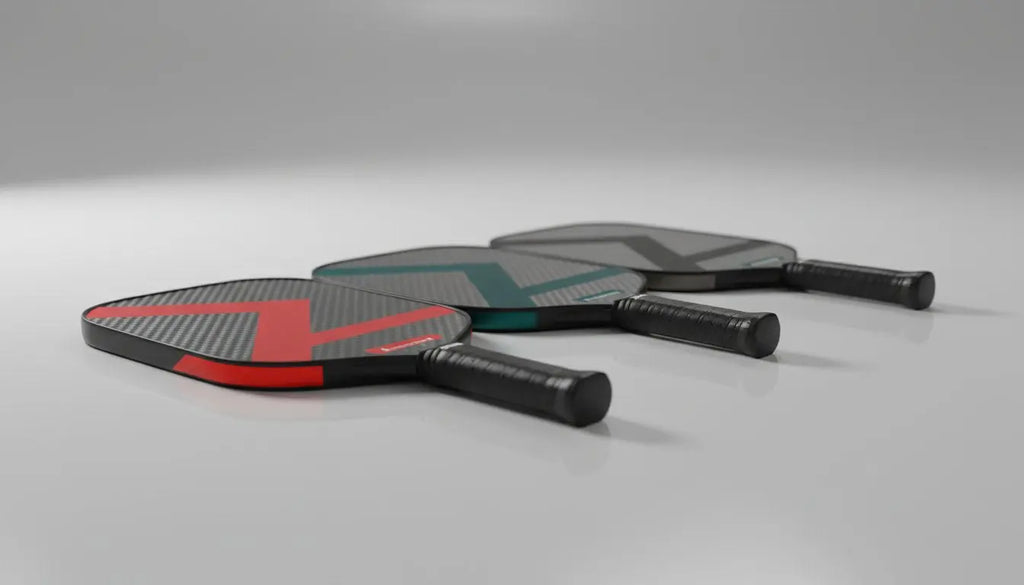
Most paddle decisions come down to a single question: what actually makes two paddles different on the court? Brand names and box specs won’t tell you. To compare pickleball paddles properly, you need to look at how each one plays — and that requires a different set of criteria than most buyers start with.
What Do Most Players Get Wrong When Comparing Paddles?
The typical starting point is weight, core material, and face material. Those three details are printed on every box and listed on every retailer page. The problem is they don’t reflect how a paddle actually performs during a real game.
Two paddles can share identical specs on paper and feel completely different in hand. One might feel planted and forgiving. The other could feel twitchy and fast. Weight alone doesn’t capture that. Neither does core material.
The traits that matter are the ones that describe performance directly: swing weight, twist weight, control, power, spin, forgiveness, touch, and consistency. These tell you how a paddle behaves, not just what it’s made of.
Which Paddle Traits Should You Actually Compare?
Swing weight determines how fast your hands move at the kitchen line. A lower swing weight means quicker reactions in fast exchanges. A higher swing weight adds stability but slows your reset time.
Twist weight measures how much the paddle face rotates when you miss the center of the hitting surface. For recreational and intermediate players, this is the single most important number. Off-center contact happens constantly, and high twist weight reduces how much those misses cost you.
Core thickness affects dwell time. A 16mm core keeps the ball on the face longer, which improves control and touch. A 14mm core snaps the ball back faster, creating more pop. Neither is inherently better — the right choice depends on your game.
Face material influences spin generation. Textured carbon fiber faces grip the ball more aggressively. Composite faces tend to offer more forgiveness and a softer feel.
How Do You Know Which Paddle Wins a Head-to-Head?
Start with the trade-off that matters most to your game. Most paddle decisions aren’t about finding a perfect paddle — they’re about choosing between two competing priorities.
Control versus power is the most common split. A high-control paddle helps you place the ball precisely during dink rallies and third-shot drops. A power-focused paddle gives you more pace on drives and overheads. You rarely get both at full strength in the same paddle.
Forgiveness versus maneuverability is another common fork. Wide-body shapes expand the sweet spot and make off-center hits more manageable. Elongated shapes improve reach and generate more leverage on groundstrokes, but they demand cleaner contact.
Knowing which trade-off you’re making is what separates a confident purchase from buyer’s remorse.
Does a Higher Price Mean Better Performance?
Not reliably. Price does tend to correlate with build consistency and twist weight, but several mid-range paddles perform on par with flagships across the traits most players actually use. The gap between a well-built paddle and a premium-priced one is often smaller than the marketing suggests.
The most efficient approach is to compare specific paddles directly — looking at normalized performance scores across each trait — rather than using price as a proxy for quality.
Where Can You Compare Pickleball Paddles Side by Side?
PickleballLookup’s comparison tool covers over 130 paddles, scored across 15 performance traits using a consistent methodology called Paddle DNA™. Every trait score means the same thing regardless of which two paddles you put next to each other. A control score of 92 on one paddle equals a control score of 92 on another — no brand-specific adjustments, no manufacturer marketing copy.
You can compare any two paddles side by side, browse curated head-to-heads organized by trade-off, or start from a paddle you already own and find its closest competitors.