
A home bartender mixing up drinks for friends or a professional crafting the perfect cocktail, mastering jigger measurements is essential for consistency and flavor balance. At Sizescalematch.com, we specialize in breaking down dimensions, weights, and measurements to make everyday tasks simpler.
Jigger?
A jigger is a small, hourglass-shaped tool used primarily in bartending to measure liquor and other ingredients for cocktails. It’s designed for precision, ensuring that each drink you make tastes the same every time. Standard jigger measurements typically range from 0.5 ounces to 2 ounces, depending on the style.
Unlike free-pouring, which relies on experience and can lead to inconsistencies, a jigger provides reliable volume control. This is crucial not just for taste but also for managing alcohol content—especially if you’re watching portions or serving responsibly. According to bartending experts, using a jigger can reduce over-pouring by up to 50%, saving money and preventing waste.
Jiggers come in various materials like stainless steel, copper, or plastic, but stainless steel is the most durable and hygienic option for frequent use.
Jigger Measurements
The origins of the jigger trace back to the 19th century, evolving from simple measuring cups to the specialized tools we know today. The term “jigger” may derive from the nautical world, referring to the smallest mast on a ship called the “jiggermast,” implying something small and precise. Another theory links it to British navy slang for a measure of rum.
In 1893, Cornelius Dungan from Chicago patented the double-sided, hourglass design that’s still popular. This innovation allowed bartenders to flip between two different volumes quickly. During the Prohibition era in the U.S., jigger measurements became even more important as speakeasies needed to stretch limited supplies.
Japanese jiggers, with their sleek, elongated shape, gained popularity in the mid-20th century, influenced by tea ceremony tools. Today, jigger measurements are standardized in professional bars worldwide, blending tradition with modern precision.
Types of Jiggers
Not all jiggers are created equal—there are several types, each suited to different bartending styles. Here’s a breakdown:
- Double-Sided Jigger (Classic Style): The most common, with two cones of different sizes. Typical jigger measurements are 1.5 oz (44 ml) on one side and 0.75 oz (22 ml) on the other.
- Japanese Jigger: Slim and tall, often with internal markings for multiple volumes. Popular sizes include 1 oz/2 oz or 0.5 oz/0.75 oz.
- Bell Jigger: Features a rounded bell shape for easy gripping. Measurements might include 1 oz and 2 oz.
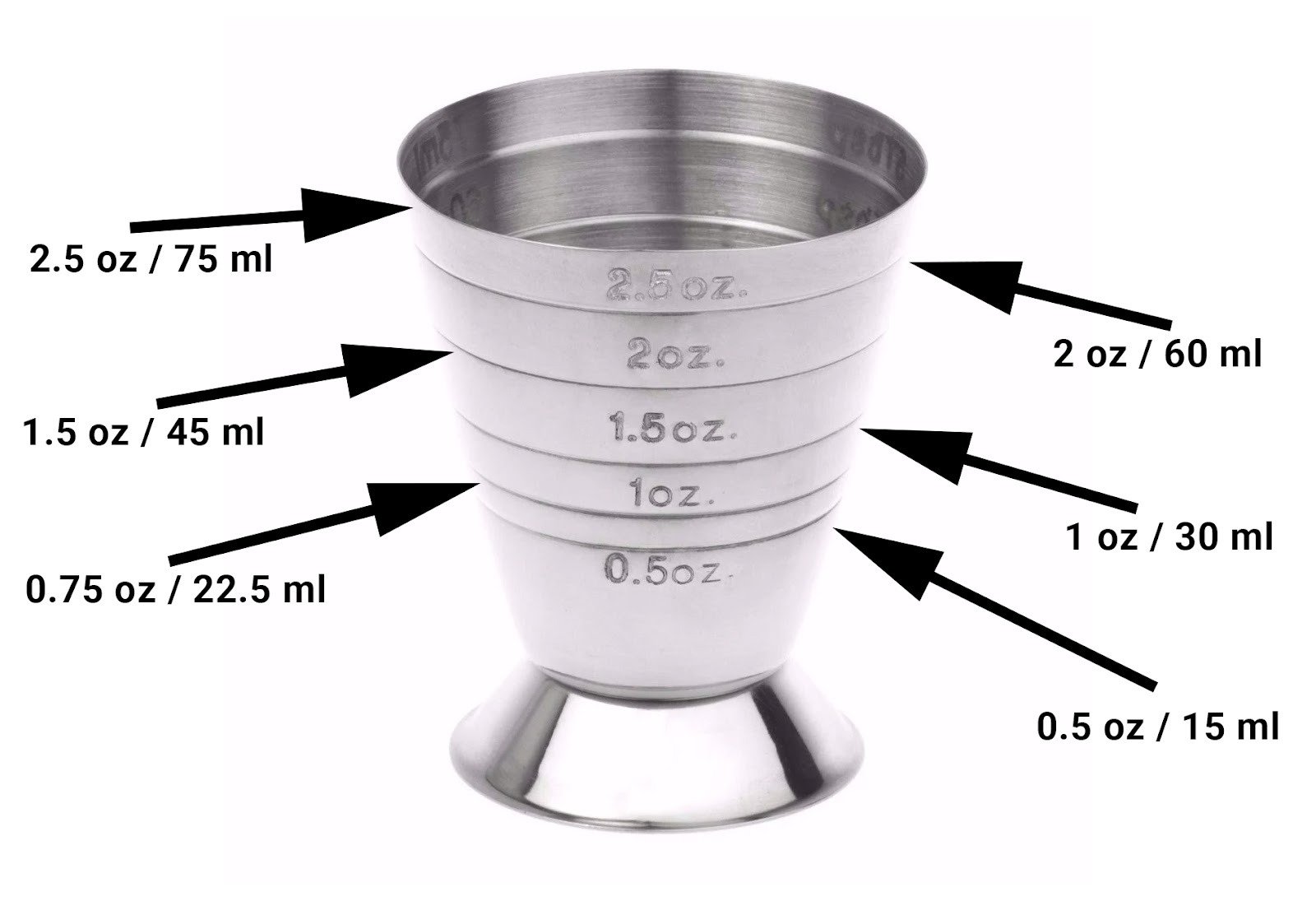
- Multi-Level or Angled Jigger: Like the OXO model, with graduated lines for flexible measuring up to 2 oz.
- Single Jigger or Shot Glass Style: Basic one-sided measure, often 1.5 oz.
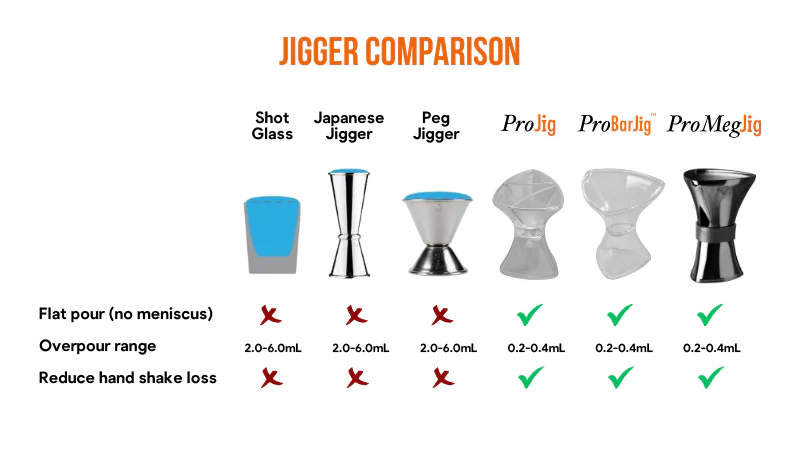
To help visualize, here’s a table of common jigger types and their standard measurements:
| Type of Jigger | Common Measurements (oz) | Equivalent in ml | Best For |
|---|---|---|---|
| Double-Sided | 1.5 / 0.75 | 44 / 22 | Classic cocktails |
| Japanese | 2 / 1 | 59 / 30 | Precision pouring |
| Bell | 2 / 1 | 59 / 30 | Professional bars |
| Multi-Level (Angled) | Up to 2 (with lines) | Up to 59 | Home bartending |
| Single | 1.5 | 44 | Quick shots |
This variety ensures you can choose based on your needs, whether you’re a beginner or pro.
Standard Jigger Measurements and Conversions
Understanding jigger measurements in both imperial and metric units is key for international recipes. A standard U.S. jigger is 1.5 fluid ounces, but conversions are straightforward.
1 oz = approximately 30 ml (though exactly 29.57 ml, bartenders often round for simplicity).
Here’s a handy conversion table for common jigger measurements:
| Ounces (oz) | Milliliters (ml) | Tablespoons (tbsp) | Teaspoons (tsp) |
|---|---|---|---|
| 0.5 | 15 | 1 | 3 |
| 0.75 | 22 | 1.5 | 4.5 |
| 1 | 30 | 2 | 6 |
| 1.5 | 44 | 3 | 9 |
| 2 | 59 | 4 | 12 |
For example, if a recipe calls for 45 ml of gin, that’s roughly 1.5 oz—perfect for a standard jigger flip. Always check your jigger’s markings, as some European models use exact metric.
How to Use a Jigger for Accurate Cocktail Making
Using a jigger is simple, but technique matters. Hold it between your thumb and forefinger, pour slowly to the rim without spilling, and level it off if needed.
Step-by-step:
- Select the right side based on the recipe’s jigger measurements.
- Pour the liquid until it reaches the brim—avoid bubbling for accuracy.
- Transfer to your shaker or glass smoothly.
For viscous ingredients like syrups, rinse the jigger between uses to prevent sticking. Pros recommend practicing with water to get the feel.
Melissa Rauch Measurements: Height, Weight, Body Stats & Comparisons
Common Cocktails and Their Jigger Measurements
Let’s apply jigger measurements to real recipes. Here are some classics from the International Bartenders Association list, with precise pours.
- Martini: 2 oz gin (59 ml), 0.5 oz dry vermouth (15 ml). Stir and strain.
- Margarita: 1.5 oz tequila (44 ml), 1 oz lime juice (30 ml), 0.75 oz triple sec (22 ml). Shake with ice.
- Old Fashioned: 2 oz bourbon (59 ml), 0.25 oz simple syrup (7 ml), 2 dashes bitters. Muddle and stir.
- Negroni: 1 oz gin (30 ml), 1 oz Campari (30 ml), 1 oz sweet vermouth (30 ml). Build over ice.
- Manhattan: 2 oz rye whiskey (59 ml), 1 oz sweet vermouth (30 ml), 2 dashes bitters. Stir.
Here’s a table of more cocktails and their key jigger measurements:
| Cocktail | Spirit (oz/ml) | Mixer 1 (oz/ml) | Mixer 2 (oz/ml) | Method |
|---|---|---|---|---|
| Daiquiri | 2 oz rum / 59 | 1 oz lime / 30 | 0.75 oz syrup / 22 | Shake |
| Mojito | 1.5 oz rum / 44 | 1 oz lime / 30 | 0.5 oz syrup / 15 | Muddle & build |
| Cosmopolitan | 1.5 oz vodka / 44 | 0.75 oz triple sec / 22 | 0.5 oz lime / 15 | Shake |
| Whiskey Sour | 2 oz whiskey / 59 | 0.75 oz lemon / 22 | 0.5 oz syrup / 15 | Shake |
| Espresso Martini | 1.5 oz vodka / 44 | 1 oz coffee liqueur / 30 | 1 oz espresso / 30 | Shake |
These recipes showcase how jigger measurements ensure balance—too much or too little can throw off the drink.
Tips for Mastering Jigger Measurements
To reduce bounce rate on your blog (and keep users engaged), here are practical tips:
- Calibrate your jigger: Not all are accurate; test with a kitchen scale.
- Go metric for precision: If traveling, switch to ml for consistency.
- Clean regularly: Residue can alter measurements.
- Experiment: Start with basic jigger measurements and tweak for personal taste.
- Buy quality: Invest in etched markings that won’t fade.
These tips, drawn from pro bartenders, will help you avoid common pitfalls.
Frequently Asked Questions
1. What are standard jigger measurements?
The most common jigger is a double-sided tool with 1.5 oz (44 ml) on the larger side and 0.75 oz (22 ml) on the smaller side. This is considered the classic “standard jigger” in the United States and most cocktail bars worldwide.
2. Is a jigger 1 oz or 1.5 oz?
It depends on the side you use. A traditional double jigger has a 1.5 oz side (called the “jigger”) and a 0.75 oz side (called the “pony”). Many Japanese-style jiggers are 2 oz / 1 oz instead.
3. How many ml is a standard jigger?
- Large side: 44–45 ml (1.5 oz)
- Small side: 22–25 ml (0.75 oz) Japanese jiggers are often 60 ml (2 oz) / 30 ml (1 oz).
4. What is the difference between a jigger and a shot?
A U.S. shot is legally 1.5 oz (44 ml) in most states, which matches the large side of a standard jigger. However, “shot glasses” sold for home use can vary from 1 oz to 2 oz, so a proper jigger is more accurate.
5. How many tablespoons are in a jigger?
- 1.5 oz jigger = 3 tablespoons
- 1 oz jigger = 2 tablespoons
- 0.75 oz (pony) = 1.5 tablespoons
- 0.5 oz = 1 tablespoon
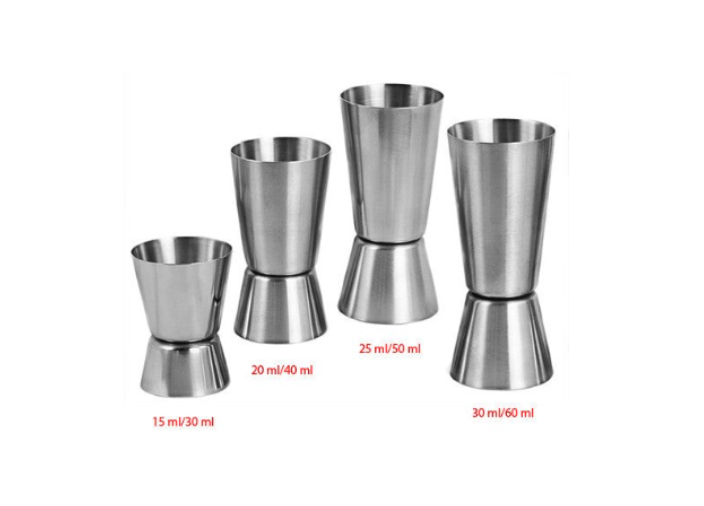
6. Why do some jiggers say 30/60 ml and others 25/50 ml?
30/60 ml is the Japanese/European standard (exactly 1 oz and 2 oz). 25/50 ml is common in the UK and Australia because their “single” and “double” spirits measures are 25 ml and 50 ml.
7. Can I use a jigger for measuring syrups and juices?
Yes! Jiggers are perfect for simple syrup, lime juice, lemon juice, or any cocktail ingredient that needs exact measurement.
8. How do I measure 1 oz without a 1 oz jigger?
If you only have a 1.5 oz / 0.75 oz jigger, fill the small side (0.75 oz) and then add half of the small side again (eyeball or use the halfway mark if your jigger has internal lines).
9. Are all jiggers accurate?
No. Cheap jiggers can be off by 5–10 ml. Always test yours with a kitchen scale or measuring cup the first time you use it.
10. What is a “measured pour” vs “free pour”?
Measured pour = using a jigger for exact jigger measurements. Free pour = counting “1-2-3-4” while pouring (experienced bartenders can hit ±0.1 oz accuracy with practice).
11. How many shots in a 750 ml bottle using a 1.5 oz jigger?
Approximately 16–17 full 1.5 oz shots (750 ÷ 44 = ~17 with a tiny bit left over).
12. Which jigger size is best for home bartenders?
A Japanese-style 2 oz (60 ml) / 1 oz (30 ml) jigger with internal measurement lines is the most versatile because it covers almost every cocktail recipe perfectly.
If you are Blessing Lover!! Then Blessing Read is just for you!!
