
Money Services Businesses (MSBs) registered with FINTRAC can face administrative monetary penalties (AMPs) if they fail to comply with Canada’s anti-money laundering and anti-terrorist financing laws.

As of the legislative amendments that came into force on March 26, 2026, the maximum penalty amounts have increased substantially. The applicable penalty framework depends on when the violation occurred.
Current FINTRAC AMP Ranges (Violations Occurring On or After March 26, 2026)
The Proceeds of Crime (Money Laundering) and Terrorist Financing Administrative Monetary Penalties Regulations classify violations into three categories:
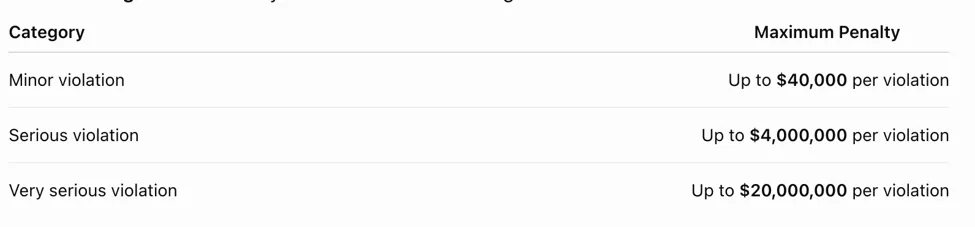
These are per violation, meaning multiple deficiencies identified during a FINTRAC examination can result in significantly larger total penalties.
Older Penalty Framework
For violations that occurred before March 26, 2026, FINTRAC continues to apply the previous AMP regime:
-
Minor: $1–$1,000 per violation
-
Serious: $1–$100,000 per violation
-
Very Serious:
-
up to $100,000 for an individual
-
up to $500,000 for an entity
FINTRAC applies the version of the law that was in force during the period under review.
What Can Trigger a FINTRAC Penalty?
Common MSB violations include:
-
failing to register with FINTRAC;
-
failing to renew an MSB registration;
-
inadequate AML compliance policies and procedures;
-
failing to conduct or document a risk assessment;
-
failing to appoint a compliance officer;
-
failing to provide AML training;
-
failing to conduct the required effectiveness review;
-
failing to verify client identity;
-
failing to keep required records;
-
failing to report suspicious transactions (STRs);
-
failing to report large cash transactions;
-
failing to report electronic funds transfers or large virtual currency transactions where required; and
-
failing to implement required sanctions or ministerial directive procedures.
Not every violation carries the same classification. Some reporting failures are classified as minor, while failures involving suspicious transaction reporting or fundamental compliance program deficiencies may be classified as serious or very serious depending on the applicable regulations.
How Does FINTRAC Decide the Amount?
FINTRAC does not automatically impose the statutory maximum.
When calculating a penalty, FINTRAC considers factors including:
-
the seriousness (or “harm”) caused by the violation;
-
the reporting entity’s compliance history;
-
the purpose of encouraging future compliance rather than punishment; and
-
under the new legislative framework, additional factors such as the reporting entity’s ability to pay may also be considered.
Can FINTRAC Publicly Name an MSB?
Yes.
Where an administrative monetary penalty is imposed, FINTRAC is generally required to publicly disclose:
-
the reporting entity’s name;
-
the nature of the violations; and
-
the amount of the penalty.
This means that, in addition to the financial consequences, an MSB may also face significant reputational harm.
Administrative Penalties vs. Criminal Charges
Administrative monetary penalties are civil regulatory penalties, not criminal convictions.
However, serious or intentional non-compliance may also constitute an offence under the Proceeds of Crime (Money Laundering) and Terrorist Financing Act, in which case law enforcement—not FINTRAC—may pursue criminal charges. FINTRAC cannot impose an administrative monetary penalty and seek criminal prosecution for the same instance of non-compliance.
Final Thoughts
The increase in FINTRAC’s penalty powers in 2026 represents one of the most significant changes to Canada’s AML enforcement regime. A single serious compliance failure can now expose an MSB to penalties measured in the millions of dollars, and multiple violations arising from one examination can produce substantially larger aggregate penalties.
Accordingly, MSBs should treat their AML compliance program as an ongoing governance function rather than a one-time registration requirement. Regular compliance reviews, updated policies, employee training, transaction monitoring, and independent effectiveness reviews can significantly reduce regulatory risk.